By Just Another First Occupier
Baybay City, Leyte, Philippines — November 5, 2026, 7:00 a.m. EST
Fifteen years ago, a bunch of Americans committed the unforgivable political sin of noticing that the country was being run for the benefit of people who already owned most of it.
We called it Occupy Wall Street.
In Chicago, we called it Occupy Chicago.
The bankers weren’t particularly amused. Neither were the politicians. And eventually, neither were some of the people who thought they owned the movement.
Welcome to the glorious history of Occupy Chicago, where we managed to confront Wall Street, challenge political corruption, survive police arrests, and then discover that internal politics could be every bit as ridiculous as the establishment we were fighting.
And somehow, fifteen years later, here we are.
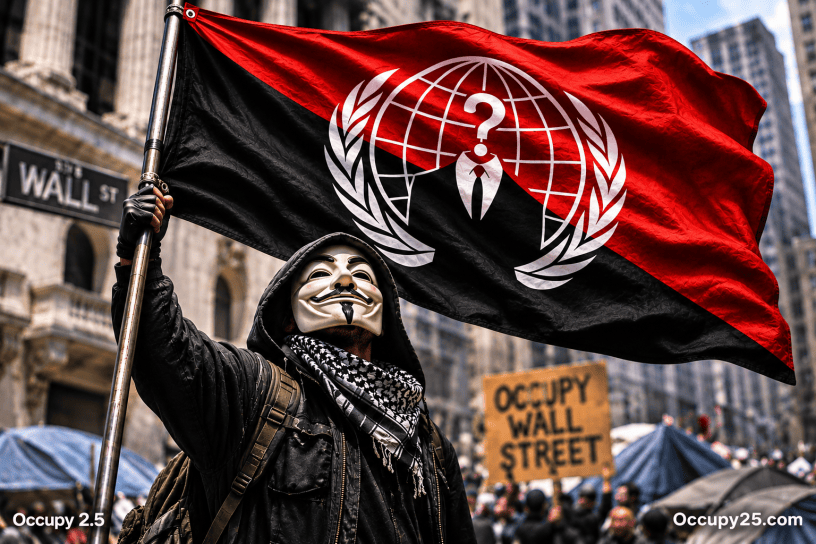
Welcome to Occupy 2.5.
When Occupying Was More Than a Hashtag
Occupy Chicago emerged in 2011 as part of the nationwide uprising against economic inequality, corporate domination, and the political influence of concentrated wealth.
The message wasn’t complicated: the American economy was working spectacularly well for the richest one percent while millions of ordinary Americans were struggling to survive.
In October 2011, thousands marched through downtown Chicago. Protesters attempted to establish an encampment in Grant Park.
Chicago’s response?
Arrest them.
Approximately 175 demonstrators were arrested on October 16. Another 130 were arrested the following weekend.
Apparently, peacefully assembling to challenge corporate power was acceptable, provided everyone went home when the park closed.
The authorities maintained that they were enforcing park regulations. Protesters argued that the arrests interfered with their constitutional rights.
The legal battles continued for years. Ultimately, the Illinois Supreme Court upheld enforcement of the park’s closing restrictions.
The lesson was unmistakable: you could protest the system, but the system still controlled the closing time (CBS News, 2011; Dudek et al., 2011; People v. Alexander, 2017).
Chicago Spring—and the Beginning of the End
Occupy Chicago wasn’t just a collection of tents and angry signs.
We organized, documented, protested, argued, and worked alongside other organizations. During Chicago Spring in 2012, activists participated in demonstrations surrounding the NATO summit, organized public discussions, and challenged the city’s political priorities.
There were real people doing real work.
There were also endless meetings, competing factions, ideological purity contests, and enough internal political maneuvering to make a Chicago alderman feel right at home.
I know. I was there.
I documented the movement on video. I worked briefly with its social-media operation. I supported Occupy Chicago long after the initial excitement faded.
And I watched the movement become increasingly consumed by its own internal problems.
By July 2012, I had withdrawn from its social-media group and continued supporting Occupy independently.
My experience was that internal factionalism, exclusion, and personality politics increasingly displaced the original mission.
Apparently, fighting economic inequality wasn’t sufficiently complicated. We needed our own miniature political establishment, complete with people deciding who was sufficiently revolutionary to participate.
Congratulations. We had invented the very nonsense we were protesting.
Occupy Chicago Becomes Chicago Rising
As the original Occupy Chicago organization declined, the name Chicago Rising emerged in 2012.
The surviving public record documents Chicago Rising’s social-media presence, but it does not establish a precise date when Occupy Chicago formally dissolved or prove that every participant transferred into a successor organization.
That distinction matters.
Movements don’t always end with a press release. Sometimes the meetings shrink, the websites stop changing, the volunteers disappear, and the people still holding the signs discover that everybody else has gone home.
Chicago Rising continued to maintain an online presence for years. The latest publicly indexed activity identified in our research dates to January 14, 2021.
That doesn’t establish when Chicago Rising ceased operating. It establishes how difficult it has become to reconstruct what happened afterward.
And perhaps that’s the most appropriate epitaph for an organization born in the internet age: eventually, even its disappearance became difficult to document.
The Websites, the Ownership, and the Irony
The original Occupy Chicago website operated at OccupyChi.org.
That domain is distinct from OccupyChicago.org, another address with its own rather unpleasant history.
OccupyChicago.org was originally controlled by an individual associated with Chicago’s Anonymous community who, in my experience, was hostile to Occupy Chicago.
I eventually acquired control of that domain myself.
Yes, one of the people who helped document and preserve the movement ended up controlling an address that had once been associated with opposition to it.
There’s a certain poetic justice in that.
I still controlled OccupyChicago.org around the movement’s tenth anniversary in 2021. After discussing the lack of interest in continuing it with Jerry, I eventually allowed the registration to lapse.
Meanwhile, OccupyChi.org remains registered. Its registration was renewed on October 30, 2026, according to a domain lookup conducted this week.
Whoever controls it today, somebody is still holding on to that piece of history.
I do not claim to own OccupyChi.org, and I do not claim exclusive ownership of the original movement.
What I do claim is my own history in it, my documentation of it, and my right to carry its unfinished work forward.
Nobody needs to grant me permission to remember what happened.
From the Ashes: Occupy 2.5
Occupy 2.5 wasn’t created because I believed the original movement had achieved its objectives.
Quite the opposite.
The movement helped popularize a language of economic inequality that remains part of American political discussion.
But concentrated wealth didn’t disappear. Corporate influence didn’t evaporate. Political accountability didn’t suddenly become fashionable.
And the working people who were struggling in 2011 didn’t all wake up wealthy in 2026.
So I built Occupy 2.5 to preserve the history, continue the investigations, and maintain the argument.
Not as the official successor to every Occupy organization.
Not as a claim that everyone who once marched in Chicago now speaks through this website.
But as a continuation of the work I personally began fifteen years ago.
An independent publication that doesn’t require permission from an assembly, a political party, a corporate sponsor, or somebody who appointed themselves guardian of revolutionary purity.
The Occupation Ended. The Reasons for It Didn’t.
This week, Occupy 2.5 begins four connected investigations.
First, this history.
Next, the Democratic Party and its long record of promising accountability.
Then, the Republican establishment and its response to the 2026 midterms.
Finally, the MAGA movement and what its supporters and organizations intend to do next.
Different subjects. One recurring question:
Who holds power, who benefits from it, and who pays when that power is abused?
That’s what Occupy was asking in 2011.
That’s what Occupy 2.5 is asking in 2026.
The old organization may have faded. The arguments may have fractured. The websites may have changed hands.
But the issues remain.
And for anyone who thought the end of Occupy Chicago meant the end of the conversation, I have some disappointing news.
We’re still here.
References
CBS News. (2011, October 16). 175 arrested in Occupy Chicago protest. https://www.cbsnews.com/news/175-arrested-in-occupy-chicago-protest/
Dudek, M., Houlihan, M., Scalzitti, J., & Sobol, R. (2011, October 23). Protesters again occupy Grant Park—and again are arrested. Chicago Sun-Times. https://chicago.suntimes.com/news/2011/10/26/18533333/protesters-again-occupy-grant-park-and-again-are-arrested
Ferrari, E. (2016). Social media for the 99%? Rethinking social movements’ identity and strategy in the corporate Web 2.0. Social Media + Society. https://doi.org/10.1177/2057047316642608
People v. Alexander, 2017 IL 120350. Supreme Court of Illinois. https://www.courthousenews.com/wp-content/uploads/2017/06/OccupyChicago.pdf
Potts, C. (2011–2026). Personal recollections, correspondence, video documentation, and archival research concerning Occupy Chicago, Chicago Rising, and Occupy 2.5. Unpublished personal archive.

