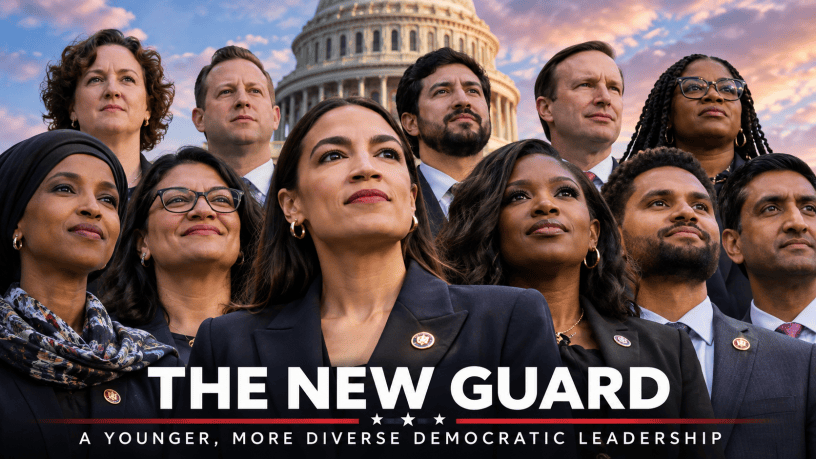
An election victory is an opportunity to govern, not a lifetime achievement award for Washington’s political establishment.
BAYBAY CITY, Philippines — November 11, 2026
The American people have spoken.
Again.
On November 3, voters handed Democrats control of both chambers of Congress, delivering a substantial rejection of Republican governance and a political warning to the Trump administration.
The final margins are still being determined, but the result is clear: Democrats will enter the next Congress with majorities in both the House and Senate.
Congratulations.
Now comes the difficult part.
And before Washington’s political establishment starts distributing leadership positions, congratulating itself, and preparing another round of speeches about bipartisanship and responsible governance, somebody needs to say something.
We have been here before.
In 2008, Americans elected Barack Obama with extraordinary expectations. Democrats controlled Congress, the economy was collapsing, and millions of Americans believed the country was finally prepared to confront the economic and political failures that had brought it to the edge of catastrophe.
What followed was a mixture of genuine accomplishments, painful compromises, and opportunities that many Americans believe were squandered.
Banks survived. Wall Street recovered. The Affordable Care Act became law. The economy eventually returned to growth.
But millions of homeowners suffered through foreclosure, working families struggled to recover, and the economic institutions responsible for much of the damage remained remarkably powerful.
The Democratic establishment that governed during those years included Nancy Pelosi, Steny Hoyer, Jim Clyburn, and influential senators such as Chuck Schumer.
Their individual records are not identical. Neither are their responsibilities.
But their collective political generation helped shape the response to the Great Recession, and that record deserves examination before anyone assumes that decades of service automatically justify continued authority.
We will examine that history separately.
For now, the immediate question is much simpler.
Who gets to lead the Democratic Party into the future?
Changing the Names Is Not Enough
Nancy Pelosi served as Speaker of the House during Obama’s first two years. Steny Hoyer was majority leader. Jim Clyburn was majority whip.
All three were central figures in the congressional establishment that helped direct the Democratic legislative agenda.
Pelosi has announced her retirement from Congress. Hoyer and Clyburn have already relinquished their former senior leadership positions.
The House Democratic leadership has changed generations.
Hakeem Jeffries, Katherine Clark, and Pete Aguilar now occupy the principal leadership positions, and they are preparing for the transition to majority control.
That is a significant institutional change.
But younger leadership does not automatically mean different leadership.
A politician can be considerably younger than a predecessor while embracing exactly the same political assumptions.
The question is not simply whether Democrats have replaced one generation of officeholders with another.
It is whether they have replaced the political thinking that repeatedly convinced Americans that meaningful economic reform was always just beyond reach.
Meanwhile, in the Senate, Chuck Schumer remains the Democratic leader.
Schumer has served in Congress since 1981, first in the House and then in the Senate. He became Senate Democratic leader in 2017.
His supporters point to his legislative experience, political relationships, and ability to manage a complicated caucus.
His critics question whether that same experience has become an obstacle to changing the party’s direction.
Those are legitimate questions for a party entering a new period of congressional authority.
Leadership should be earned through demonstrated ability, public accountability, and a convincing vision for the future.
It should not be treated as a reward for surviving long enough to accumulate seniority.
The Generation That Will Inherit the Consequences
Consider Alexandria Ocasio-Cortez.
She entered Congress in 2019, long after the financial crisis and the first Obama administration’s major legislative battles.
Her political generation came of age in a country where student debt could follow someone for decades, homeownership increasingly seemed unattainable, and affordable health care remained a financial challenge even for people who worked full-time.
That generation inherited the consequences of decisions made long before its members reached positions of authority.
Ocasio-Cortez is not the only representative of that generation, nor should any single politician be expected to carry its entire future.
There are younger lawmakers, reformers, and newly elected members throughout Congress who bring different experiences and priorities to national politics.
Some are progressive. Some are moderate. Some will disagree bitterly with one another.
That is democracy.
The point is not that younger politicians are automatically wiser.
They are not.
The point is that they deserve meaningful opportunities to participate in decisions that will shape the country for the next thirty or forty years.
They should not have to wait until every member of the preceding political generation voluntarily retires.
And they should not be expected to accept every institutional assumption handed down to them simply because somebody older insists that Washington has always operated that way.
I Am 69 Years Old. I Understand Something About This.
Before somebody decides this is another attack on older Americans, let me establish something.
I am 69 years old.
I have been around long enough to see political movements rise, governments fall, promises broken, and people with extraordinary confidence discover that they were spectacularly wrong.
I have made mistakes myself.
Plenty of them.
And if living nearly seven decades has taught me anything, it is that experience does not make a person infallible.
Sometimes experience gives us wisdom.
Sometimes it gives us bad habits.
Sometimes it teaches us how to solve problems.
And sometimes it convinces us that the way we have always done something is the only way it can possibly be done.
That last one is particularly dangerous in government.
I have no objection to older politicians sharing their knowledge.
Quite the opposite.
If someone wants my advice, I am more than happy to offer it.
If someone wants to know what mistakes I have made, I can probably keep them entertained for hours.
If I have learned something useful over the years, I would consider it a privilege to pass that knowledge along.
But I do not believe that my generation possesses a permanent entitlement to make decisions for everyone who comes after us.
We have had our turn.
We have done some wonderful things.
We have made some terrible mistakes.
We have built institutions worth preserving and created problems that future generations will spend decades trying to repair.
At some point, we have to recognize that the people who will inherit those consequences deserve the authority to determine what happens next.
That is not surrender.
That is responsibility.
A Congressional Majority Is Not a Blank Check
The November election delivered Democrats an extraordinary political opportunity.
It did not deliver unlimited authority.
Donald Trump remains president. Congressional Democrats will have to contend with presidential vetoes, Senate procedures, internal disagreements, and the practical limitations of divided government.
But those obstacles do not excuse a lack of direction.
Americans are dealing with problems that cannot be solved by congratulatory speeches.
Affordable housing.
Accessible health care.
Decent wages.
Food on the table.
Retirement security.
The ability to raise children without wondering whether one medical emergency or unexpected expense will destroy the family finances.
And perhaps most importantly, a future that ordinary people can reasonably look forward to.
These are not extravagant demands.
They are the basic expectations of a society that claims to offer opportunity and economic security.
The Democratic leadership will be judged by how seriously it addresses those expectations.
That includes the new House leadership.
It includes the Senate leadership.
And it includes the younger members of Congress who are demanding a greater voice in shaping the party’s priorities.
No generation gets a free pass.
Not mine.
Not theirs.
The Undiscovered Country
There is a phrase from Star Trek VI: The Undiscovered Country that seems appropriate here.
The undiscovered country.
The expression originates in Shakespeare’s Hamlet, where it refers to death. But in the film’s political story, it also evokes the uncertainty of a future that established leaders must find the courage to confront.
That is where America stands.
At the edge of an undiscovered country.
The next generation will confront artificial intelligence, economic upheaval, climate instability, technological disruption, international conflict, and social problems that previous generations could barely have imagined.
We cannot expect them to navigate that future entirely through the assumptions of the twentieth century.
Nor can we expect them to develop the experience necessary for leadership while refusing to give them meaningful opportunities to lead.
They will make mistakes.
Of course they will.
Didn’t we?
They will make decisions we disagree with.
Certainly.
Haven’t younger generations always disagreed with their elders?
But the future does not become less uncertain because we refuse to hand over the steering wheel.
It simply becomes a future controlled by people who will not have to live with its consequences for as long.
Democrats, Don’t Waste This
The Democratic Party has another opportunity to demonstrate what congressional leadership can accomplish.
It should approach that opportunity with an honest assessment of its past, an understanding of its present responsibilities, and a willingness to make room for the people who will shape its future.
The accomplishments of Pelosi, Hoyer, Clyburn, Schumer, and their contemporaries belong in the historical record.
So do their compromises and failures.
Experience deserves respect.
It does not confer permanent ownership of political authority.
The younger generation does not need to erase the past. It needs the freedom to learn from it.
And those of us who have spent most of our lives watching American politics unfold need to recognize something.
This is not our country to run forever.
It belongs to the people who come after us just as much as it belongs to us today.
We have driven this country long enough.
Some of the roads we built were magnificent.
Some of them led straight into a ditch.
Now it is time to let somebody else take the wheel.
The undiscovered country is waiting.
And the next generation deserves the chance to discover it.
References
Associated Press. (2026, November 5). Calling control of Congress in the 2026 midterm elections. https://www.ap.org/the-definitive-source/behind-the-news/calling-control-of-congress-in-the-2026-midterm-elections/
Associated Press. (2026, November 11). More than a dozen key races remain too early to call one week after Election Day. https://apnews.com/article/90ce111a971a0f70ba938d27fe69f65d
Axios. (2026, November 11). The Democratic leadership revolt has a glaring problem. https://www.axios.com/2026/11/11/democratic-leadership-congress-jeffries-schumer
Bloomberg Government. (2026, November 6). Tight-knit Democratic trio prepares to lead the House majority. https://news.bgov.com/bloomberg-government-news/tight-knit-democratic-trio-prepares-to-lead-the-house-majority
U.S. House of Representatives. (n.d.). Leadership. https://www.house.gov/leadership
The Washington Post. (2026, November 10). Progressive activists aim to block Jeffries, Schumer from leading Democrats. https://www.washingtonpost.com/politics/2026/11/10/progressive-activists-aim-block-jeffries-schumer-leading-democrats/

