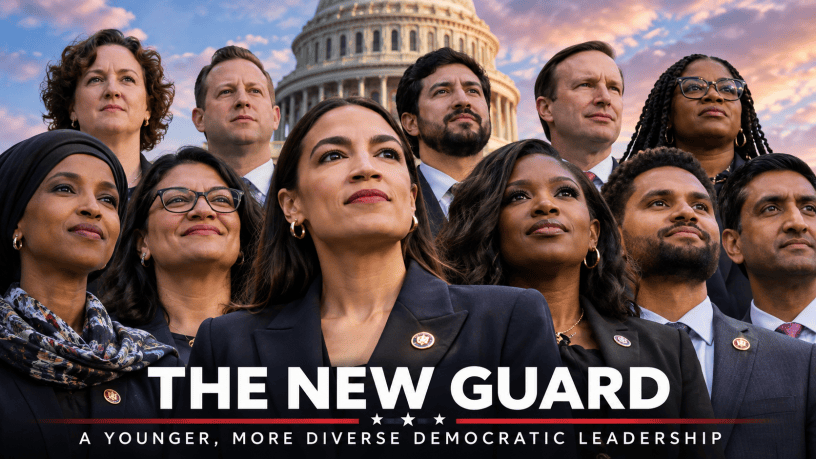
Nearly twenty years after the Great Recession began, the economic decisions of Washington’s political establishment remain central to the debate over congressional leadership.
By Just Another First Occupier
The Great Recession began in December 2007.
Not September 2008, when Lehman Brothers collapsed. Not January 2009, when Barack Obama entered the White House.
December 2007.
That is the official beginning established by the National Bureau of Economic Research (2008).
When the next Congress convenes in January 2027, more than nineteen years will have passed since the American economy began its descent into the worst financial catastrophe since the Great Depression.
And the political establishment will still be arguing about what lessons it should have learned.
The banks were rescued. The financial system was stabilized. Wall Street eventually recovered.
Meanwhile, millions of Americans endured unemployment, foreclosure, destroyed savings, and years of economic insecurity.
The federal response prevented a potentially worse collapse. That achievement matters.
But so does the question that has haunted American politics ever since:
Why could Washington mobilize extraordinary resources to protect financial institutions while struggling to deliver timely, effective relief to families losing their homes?
And why, nearly twenty years later, are so many of the economic assumptions that shaped that response still part of American political life?
The Economic Philosophy Behind the Disaster
The financial crisis did not emerge from nowhere.
For decades, American economic policy had increasingly embraced market-oriented ideas commonly associated with neoliberalism.
Deregulation. Privatization. Financial liberalization. International capital mobility. And the conviction that private enterprise, properly encouraged, would deliver prosperity throughout society.
Republicans championed these ideas.
So did influential Democrats.
During the Clinton administration, financial deregulation and international trade liberalization became important elements of Democratic economic policy.
Supporters argued that competitive markets would attract investment, encourage innovation, expand business activity, and create jobs.
Critics warned that weakening financial safeguards, concentrating corporate power, and allowing economic gains to flow disproportionately toward investors would leave working families increasingly vulnerable.
The Great Recession exposed serious weaknesses in the financial system.
The Federal Reserve’s historical account documents collapsing housing prices, enormous losses in household wealth, severe unemployment, and the financial instability that followed the housing-market collapse (Rich, 2013).
But the crisis also exposed a fundamental contradiction.
When private financial institutions were profitable, market discipline and limited government intervention were frequently celebrated.
When those institutions approached collapse, extraordinary government assistance became indispensable.
That intervention had a legitimate economic purpose: preventing a breakdown that could have devastated employment, commerce, and household savings.
Nevertheless, the contrast raised an unavoidable question.
If government could intervene so decisively to protect financial institutions, why was comparable protection for ordinary households so difficult to deliver?
The Democrats Who Were in Charge
When Barack Obama took office in January 2009, Democrats controlled the House and Senate.
Nancy Pelosi was Speaker of the House.
Steny Hoyer was House majority leader.
Jim Clyburn was House majority whip.
Harry Reid led the Senate majority, while Chuck Schumer was an influential Democratic senator and member of the party’s leadership structure.
These politicians were not responsible for creating the Great Recession.
The crisis began during the George W. Bush administration, following years of accumulating financial risks and regulatory failures.
But Democratic congressional leaders helped determine the legislative response after Obama entered office.
And they possessed an extraordinary opportunity to reconsider the economic policies that had preceded the collapse.
Congress enacted the American Recovery and Reinvestment Act in February 2009.
The following year brought the Affordable Care Act and the Dodd-Frank Wall Street Reform and Consumer Protection Act.
These were substantial legislative accomplishments.
The stimulus supported employment, public investment, and state government finances. Dodd-Frank introduced additional financial oversight and consumer protections. The Affordable Care Act expanded health insurance coverage.
Those achievements deserve recognition.
But their existence does not settle the larger debate over whether the response sufficiently changed the relationship between financial institutions, government, and working Americans.
The political establishment could point to legislation passed.
Millions of households were still confronting economic devastation.
The 1,711 Homeowners
Perhaps no episode illustrates the gap between Washington’s ambitions and its execution more clearly than the Home Affordable Modification Program, or HAMP.
The Obama administration introduced HAMP to help struggling homeowners avoid foreclosure.
The program depended heavily on mortgage servicers to evaluate borrowers and modify eligible loans.
Its early performance was deeply disappointing.
In April 2010, the Congressional Oversight Panel published its evaluation of federal foreclosure-mitigation programs.
The panel recalled that when it examined the crisis in October 2009, approximately one in eight mortgages was already in foreclosure or default.
An additional 250,000 foreclosures were beginning every month.
And six months after the foreclosure-relief programs had been announced, HAMP had produced only 1,711 permanent mortgage modifications (Congressional Oversight Panel, 2010).
That figure described the program’s early implementation, not its eventual lifetime results. The program subsequently assisted many more borrowers.
But the initial failure was substantial.
The Government Accountability Office also identified weaknesses in Treasury’s administration, transparency, and accountability mechanisms (GAO, 2009).
Mortgage servicers were responsible for processing applications. Treasury administered the program. Congressional leaders were not personally deciding which homeowners received modifications.
Nevertheless, Congress possessed legislative and oversight authority.
It could investigate failures, demand explanations, and consider additional measures.
The question was whether the federal response was sufficiently accountable to the families it was supposed to protect.
For people losing their homes, the distinction between legislative intent and administrative performance offered little comfort.
They needed results.
Protect the Corporation, Protect the Job?
The argument that government must protect businesses to preserve employment contains an important economic truth.
Businesses employ workers.
Credit allows employers to operate.
Investment supports production.
When viable businesses collapse because financial markets stop functioning, employees and communities can suffer enormously.
That was one reason federal officials considered financial stabilization essential during the crisis.
But protecting a business does not automatically protect its employees.
Corporate profitability does not guarantee higher wages.
A rising stock market does not guarantee affordable housing.
Economic growth does not necessarily reach every community or household at the same pace.
And assistance to financial institutions does not automatically translate into relief for people facing foreclosure.
These distinctions matter when government uses public resources to intervene in the economy.
An economic rescue can be evaluated through several different measures.
Did it prevent systemic collapse?
Did it preserve employment?
Did it protect household wealth?
Did it reduce foreclosures?
Did it improve financial security for ordinary Americans?
The answers need not be identical.
The federal government may succeed at stabilizing financial markets while producing disappointing outcomes for households.
That is precisely why the Great Recession remains such an important case study.
The economic debate is not simply whether government should help businesses.
It is whether the benefits and obligations of government intervention are distributed fairly, transparently, and effectively.
What Happened to the American People?
The Federal Reserve’s historical research shows that household and nonprofit net worth fell from approximately $69 trillion in 2007 to $55 trillion at its recession-era low.
Average home prices declined approximately 30 percent between their mid-2006 peak and mid-2009.
Unemployment reached 10 percent in October 2009, even though the recession had officially ended in June (Rich, 2013).
These numbers describe economic devastation on an enormous scale.
But numbers alone cannot convey the human consequences.
A family losing its home does not experience foreclosure as an economic indicator.
A worker losing a career does not experience unemployment as a percentage.
A retiree watching decades of savings disappear does not experience financial collapse as a temporary market correction.
The damage becomes part of their lives.
And for many Americans, the consequences extended far beyond the official end of the recession.
The recovery was real, but it was uneven.
That unevenness became part of the political legacy of the crisis.
The Political Establishment and Its Record
The Democrats lost their House majority in the 2010 midterm elections.
The causes included high unemployment, dissatisfaction with the economic recovery, opposition to health care reform, concerns about federal spending, and intense Republican political mobilization.
It would be inaccurate to attribute that defeat to one policy or one congressional leader.
Nevertheless, the election demonstrated that major legislative achievements do not automatically produce public confidence.
Pelosi, Hoyer, Clyburn, and Schumer each had different responsibilities and different records.
Their decisions should be evaluated individually rather than treated as interchangeable.
Pelosi helped secure passage of major legislation, including the Affordable Care Act.
Hoyer played a central role in managing the House majority’s legislative agenda.
Clyburn helped assemble the votes necessary for Democratic priorities.
Schumer participated in the Senate’s economic and financial-policy debates, although Harry Reid, not Schumer, was majority leader.
The historical criticism is not that these politicians accomplished nothing.
It is that the broader response preserved much of the existing economic structure while leaving unresolved questions about financial concentration, household vulnerability, and corporate influence.
Supporters of the administration argue that emergency stabilization prevented a far greater economic collapse and that legislative compromises reflected the limits of congressional votes.
Critics argue that those same compromises protected existing institutions more effectively than they transformed the economic conditions that had made ordinary Americans vulnerable.
That disagreement remains central to the interpretation of the period.
Nearly Twenty Years Later, Congress Faces the Questions Again
The November 2026 elections have returned Democrats to control of both chambers of Congress.
President Donald Trump remains in the White House, creating a divided government in which legislation will face presidential veto power, Senate procedural obstacles, and disagreements within Congress.
The incoming Democratic leadership is also the subject of internal debate.
Hakeem Jeffries is positioned to become Speaker of the House, while Chuck Schumer expects to become Senate majority leader. Their leadership selections have not yet been completed.
Younger members, including Alexandria Ocasio-Cortez, are part of a broader discussion about the party’s direction and economic priorities.
The question extends beyond the age of individual politicians.
It concerns the assumptions they bring to government.
Should financial stability be measured primarily through the condition of banks and markets, or should household economic security receive equal attention?
What obligations should accompany public assistance to private corporations?
How should Congress respond when financial institutions recover faster than the people who depend on them?
What oversight mechanisms can prevent emergency programs from becoming ineffective bureaucracies?
And what would demonstrate that the next generation of congressional leaders has learned from the failures of the previous one?
Those questions have concrete policy implications for housing, wages, health care, financial regulation, taxation, and public investment.
They cannot be resolved merely by changing the names on congressional office doors.
The Unfinished Lesson
The Great Recession began in December 2007.
By the time the next Congress takes office, nearly twenty years will have passed.
The crisis was caused by systemic financial weaknesses, not by one politician or one political party.
Its response included essential stabilization measures, substantial legislative achievements, and serious shortcomings in the delivery of household relief.
Those facts belong together.
The historical record does not support pretending that rescuing financial institutions was unnecessary.
Neither does it support treating the survival of those institutions as sufficient evidence that the American people received the protection they needed.
The next Congress will confront its own economic challenges under very different circumstances.
Its members will disagree about the appropriate role of government, the responsibilities of business, and the best means of improving economic security.
Those disagreements deserve serious examination.
But the fundamental question remains unchanged.
When Washington declares that it has saved the economy, who actually benefits?
Nearly twenty years after the Great Recession began, that is still the question congressional leaders must answer.
And it is a question the American people have every reason to keep asking.
References
Congressional Oversight Panel. (2010, April). Evaluating progress on TARP foreclosure mitigation programs: April oversight report. U.S. Government Printing Office. https://www.govinfo.gov/content/pkg/CPRT-111JPRT55737/html/CPRT-111JPRT55737.htm
Government Accountability Office. (2009). Troubled Asset Relief Program: Treasury actions needed to make the Home Affordable Modification Program more transparent and accountable (GAO-09-837). https://www.gao.gov/products/gao-09-837
Kight, S. W., Santaliz, K., & Solender, A. (2026, November 11). The Democratic leadership revolt has a glaring problem. Axios. https://www.axios.com/2026/11/11/democratic-leadership-congress-jeffries-schumer
McDaniel, E., & Grisales, C. (2026, November 4). Democrats win full control of Congress, ushering in a new era of divided government. NPR. https://www.wbur.org/npr/g-s1-149526/2026-midterms-congress-balance-of-power
National Bureau of Economic Research. (2008, December 1). Business Cycle Dating Committee announcement December 1, 2008. https://www.nber.org/news/business-cycle-dating-committee-announcement-december-1-2008
Rich, R. (2013). The Great Recession. Federal Reserve History. https://www.federalreservehistory.org/essays/great-recession-of-200709
U.S. Bureau of Labor Statistics. (2012). The recession of 2007–2009. https://www.bls.gov/spotlight/2012/the-recession-of-2007-2009/home.htm

